North America ↗
Total surface area24,709,000 km² (more)editorial estimate
Population611,697,535 (more)2025
Population density24.8 per km² (more)editorial estimate
TypeContinent
North America is larger: 24,709,000 km² (editorial estimate) versus 17,840,000 km² (editorial estimate) for South America, or about 39% more.
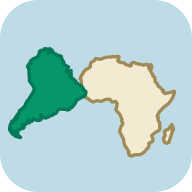
Both areas at the same scale: North America and South America. Drag the outlines, separate them and see what the Mercator map hides.
Drag the outlines to overlap them, or place them side by side.
True area tells a different story than the Mercator map.
South America equals about 72% of the area of North America, a gap of about 6,869,000 km².
North America has 1.4× the population of South America. North America is 1.01× as dense.
Area multiplier at each center: 2.6× (North America, 52°) and 1.06× (South America, 14°).
The Mercator projection enlarges areas more and more the farther they lie from the equator. The centers of the two areas lie about 52° (North America) and 14° (South America) from the equator. An estimate based on each center’s latitude gives an area ratio of 3.4 : 1, compared with the real ratio of 1.4 : 1. This is not a measurement of the entire outlines on a Mercator map.
Tip: You can also compare these items dynamically by clicking the link below and dragging them directly across the global interactive map.
At least one value represents a continent: its area is an editorial estimate of the whole landmass, and its population is the sum of the 2025 World Bank figures of its countries (all of Russia counted in Europe). Treat the result as an approximation. The overlay uses an equal-area projection. Coastal outlines are simplified and do not include all waters counted in the statistics. Their area ratio can therefore differ from the ratio of official total areas. Geometry: Natural Earth, public domain. Read the methodology ↗
The Mercator projection preserves angles, but it stretches surface area more and more with distance from the equator. The center of the outline for North America lies about 52° from the equator (where the local Mercator area scale reaches about 2.6×), compared with about 14° for South America (about 1.06×). That latitude difference shifts the apparent size ratio on a Mercator map to about 3.4 : 1, compared with the true area ratio of 1.4 : 1.
The area difference is about 6,869,000 km², with North America covering 24,709,000 km² (editorial estimate) and South America covering 17,840,000 km² (editorial estimate). The smaller territory equals about 72% of the larger one (a ratio of 1.4 : 1). The area gap between the two territories is close to the total area of Australia (7,692,024 km²).
North America has the larger population: 611,697,535 residents compared with 437,788,241 in South America (a ratio of about 1.4 : 1). Population density measured over land area is higher in North America at 24.8 people per km², compared with 24.5 per km² in South America (about 1.01 times as dense).