How big is the Pacific Ocean?
Surface area (65.1 million sq mi)
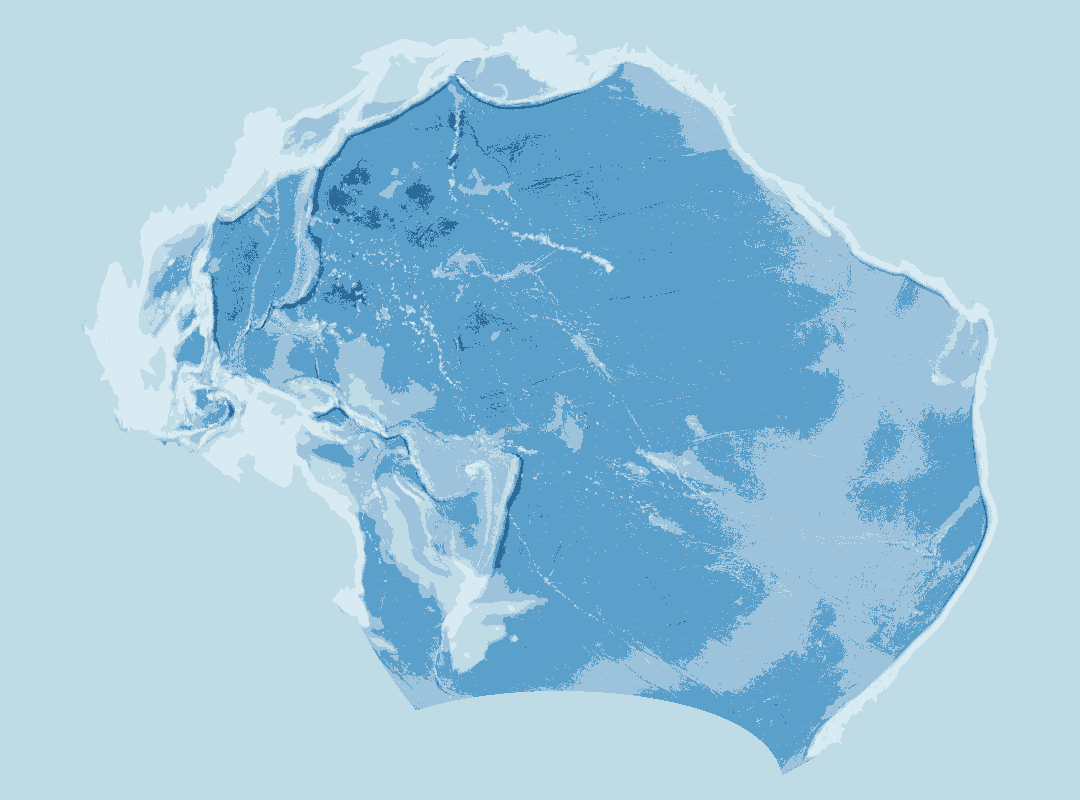
The Pacific covers 168.7 million km² (65.1 million sq mi), nearly half the world ocean and more than all of Earth's land combined. It is the deepest ocean too: about 3,970 m (13,025 ft) on average and 10,924 m (35,840 ft) in Challenger Deep of the Mariana Trench.
- Mean depth
- 3,970 m (13,020 ft)
- Deepest point
- 10,924 m (35,840 ft)
- Location
- From the Bering Strait to 60°S, between Asia and Australia and the Americas
- In NOAA's figures
- With the South-East Asian seas, down to 60°S
How many times would the United States fit in the Pacific Ocean?
The Pacific Ocean would fit the United States about 17 times: 168,723,000 km² (65.1 million sq mi) against 9,833,517 km² (3.8 million sq mi). The pink shape is the United States at real scale, laid in the ocean.
Pacific Ocean seabed cross-section: Philippines via Mariana Trench to California
The line runs from Luzon in the Philippines across Challenger Deep in the Mariana Trench and past Hawaii to San Francisco. Mount Everest stands on the floor of Challenger Deep.
Cross-section from the GEBCO_2026 grid (2′ cells, about 3.7 km). The grid smooths the seabed, so the deepest spot (Challenger Deep) reads about 10,743 m on it against 10,924 m measured.
Pacific Ocean compared with the other four oceans
The bars show the area of all five oceans and, for comparison, all of Earth's land.
The Pacific Ocean: area, volume and Mariana Trench
In NOAA's table the Pacific covers 161.8 million km² (62.5 million sq mi), and 168.7 million km² (65.1 million sq mi) with the South-East Asian seas listed alongside it. That equals 46.6% of the world ocean's area and half of all ocean water, about 670 million km³. Test your own intuition in our Pacific vs all land experiment, or explore its major marginal basins: the Philippine Sea, Coral Sea, South China Sea and Bering Sea.
Earth's deepest spot, Challenger Deep, sits at the southern end of the Mariana Trench. High-resolution multibeam mapping by the Five Deeps team (Bongiovanni, Stewart and Jamieson 2022) puts it at 10,924 m (35,840 ft). Stand Mount Everest (8,849 m / 29,032 ft) on its floor and more than 2 km (6,800 ft) of water would still cover its peak.
- Water volume
- 669.9 million km³
- Share of the world ocean
- 46.6% of the area, 50.2% of the water
Pacific Ocean: questions and answers
About 168.7 million km² (65.1 million sq mi) including the South-East Asian seas, or 46.6% of the world ocean. That is more than all of Earth's land put together (148.9 million km² / 57.5 million sq mi), which you can test in our Pacific vs all land experiment.
About 3,970 m (13,025 ft) on average, the deepest of any ocean. Its deepest point, Challenger Deep in the Mariana Trench, reaches 10,924 m (35,840 ft).
In Challenger Deep at the southern end of the Mariana Trench, in the western Pacific, at 10,924 m (35,840 ft). Mount Everest stood on its floor would lie under more than 2 km (6,800 ft) of water.
Nearly twice as large: the Pacific covers 168.7 million km² (65.1 million sq mi) against 85.1 million km² (32.9 million sq mi) for the Atlantic Ocean, and holds more than twice the water (670 million km³ vs 310 million km³).
The Pacific Ocean covers 168.7 million km² (65.1 million sq mi) and the United States 9,833,517 km² (3.8 million sq mi), so it would fit about 17 times.
Sources and data year
- NOAA NCEI: World Ocean Volumes (Eakins and Sharman 2010) (2010)
- Bongiovanni, Stewart and Jamieson (2022): High-resolution multibeam sonar bathymetry of the deepest place in each ocean, Geoscience Data Journal 9(1), 108-123 (2022, CC BY 4.0)
- USGS: Earth's land area (148.94M km² / 57.5M sq mi) (2019)
- Mount Everest: 8,848.86 m (29,032 ft) in the 2020 joint survey of China and Nepal.
- GEBCO_2026 Grid · public domain (GEBCO Bathymetric Compilation Group 2026): depth map and cross-section.
- Natural Earth · public domain. Outlines assembled from its marine areas, simplified and reprojected.